The right to learn, without barriers
Once forced to avoid water, Sujon now attends school confidently thanks to accessible WASH facilities.
For Sujon, every school day began with a calculation most of his classmates never had to make: how little water could he drink and still make it through the day?
It was not a question any child should have to ask. Yet for Sujon, a class ten student with a physical disability, thirst had become a form of protection.
At the schools he previously attended, the washrooms were inaccessible to wheelchair users. Entrances were too narrow. Steps blocked the way. Taps were positioned too high. Drinking water meant risking the need for a toilet he could not enter. Avoiding water meant thirst, discomfort and the exhausting strain of asking his body to wait.
I avoided drinking water because it meant I would need to use the toilet, which I couldn’t reach in my wheelchair.
So Sujon learned to ration something as basic as water. He planned his day around inaccessible spaces. Before leaving home, he had to think not only about lessons, books and homework, but also about whether his body might need something the school could not provide.
No student should have to choose between staying hydrated and staying in class. Yet this choice shaped Sujon’s ordinary school life.
His attendance became irregular. His health suffered. Concentrating in class became harder when he was thirsty or uncomfortable. While other students moved between lessons without a second thought, Sujon had to study every doorway, corridor and washroom before deciding where he could go. Even the most routine parts of the day required planning, caution and, too often, someone else’s help.
The problem was never Sujon’s wheelchair. The problem was everything that had been designed without him in mind.
A school may welcome every child through its gate, but true inclusion does not end at admission. It must continue through the classroom door, along the corridor, beside the drinking-water point, and inside the washroom. Without that access, a student may be present on the register yet excluded from the school day itself.
At Shaheed Suhrawardy High School, this began to change.
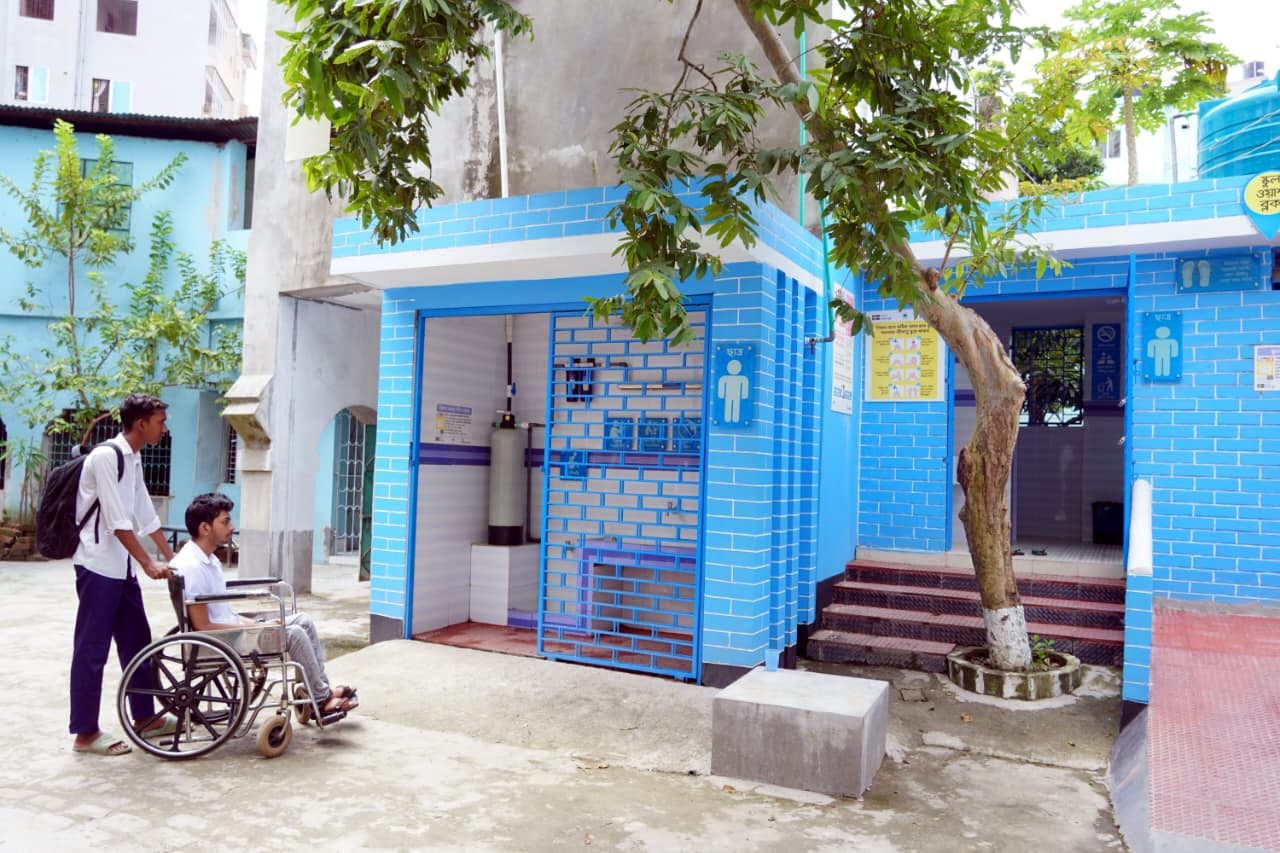
Through an intervention by WaterAid Bangladesh and Nabolok, the school introduced practical changes to make its water, sanitation and hygiene facilities more accessible. Ramps were constructed. Taps were lowered. An accessible toilet was installed with features that allowed students with disabilities to use it safely and privately.
The modifications appeared simple. Their impact was anything but small.
For the first time, Sujon could move through the school with greater freedom. He could reach drinking water by himself. He could use the toilet without depending on another person. He could remain in class without constantly worrying about what might happen if he needed to leave.
The school day was no longer a test of endurance.
Having these accessible facilities changed everything. Now, I don’t miss school anymore. This isn’t just about a toilet. It is about the school saying, “You are an equal student here, and we expect you in class.”
That message matters.
For a student who had repeatedly encountered spaces that seemed to say, “This place was not built for you,” an accessible facility offers a very different answer. It says that his comfort matters. His privacy matters. His health matters. His education matters.
A ramp is made of concrete, but it can also be an invitation.
A lowered tap may seem like a small adjustment, yet it can return independence to someone who has repeatedly been asked to surrender it. An accessible toilet is not merely a piece of infrastructure. It can mark the difference between dependence and dignity, between absence and participation, between leaving early and staying until the final bell.
These changes have transformed more than Sujon’s physical surroundings. They have changed the way he experiences school.
He no longer has to wait for someone to help him reach water. He no longer has to avoid drinking because of what might follow. He no longer has to treat his body’s most basic needs as problems to be hidden or postponed.
Inclusion, for Sujon, is no longer an abstract promise written in a policy or spoken at a meeting. It is built into the route he takes each morning. It is there in the ramp beneath his wheels, in the tap within his reach and in the washroom where he can close the door and have the privacy every student deserves.
It is also present in something less visible but equally powerful: the knowledge that he belongs.
Now, Sujon can drink water without rehearsing the consequences. He can focus on lessons rather than calculating how long he can wait. He can take part in the school day as a student, not as someone constantly negotiating with a space that was never designed for him.
His story is a reminder that accessibility is not an optional improvement or a special favour. It is a fundamental part of the right to education. A child cannot learn freely in a place where drinking water, using a toilet or moving between spaces comes at the cost of dignity.
When schools become accessible, students do more than enter buildings. They gain the freedom to participate, to grow, to form friendships and to imagine a future in which they are not treated as an afterthought.
For the first time in a long time, school does not feel like a place Sujon must endure. It feels like a place that sees him, expects him and has finally made room for him.